
SECURE CONSTRUCTION IN A WORLD OF UPHEAVAL Why SCIF Readiness Can’t Wait
Heightened geopolitical risk, evolving compliance expectations and constrained secure-facility supply chains are changing how government and defense contractors plan, build and modernize SCIFs. For Surface Solutions, the opportunity is clear: specialized execution, early coordination and DMV-region proximity, specialized execution and accountability are becoming more valuable as secure projects grow more complex.
Illustrative secure-facility environment. Actual SCIF configurations and technical requirements vary by program and accrediting authority.
| $350-$1,000 JLL estimated average cost per square foot for a SCIF, depending on scope. |
12-18 MOS. Typical accreditation timeline cited by JLL for current SCIF spaces. |
24-36 MOS. Potential timeline under heavier demand, according to JLL. |
A New Era of Secure Construction
The case for secure facilities is becoming more urgent. JLL’s industry analysis describes a U.S. aerospace and defense market shaped by a heightened threat environment and continued modernization of military capabilities, with demand for Sensitive Compartmented Information Facilities (SCIFs) rising as a result.
The current geopolitical environment reinforces that sense of urgency. As of September 2026, renewed U.S.-Iran clashes and further disruption around the Strait of Hormuz have demonstrated how quickly strategic conditions can change. Those events do not create a SCIF requirement by themselves, but they are a reminder that intelligence, defense and mission continuity depend on secure infrastructure that is planned before a crisis—not after one.
A SCIF can be a room, a containerized environment, a data-center space, an entire floor or even a larger dedicated facility. What matters is not size; it is the ability to protect Sensitive Compartmented Information through a coordinated physical and technical security strategy.
|
Security infrastructure is no longer a back-end construction detail. For defense contractors and government agencies, SCIF readiness is increasingly a mission-planning issue. |
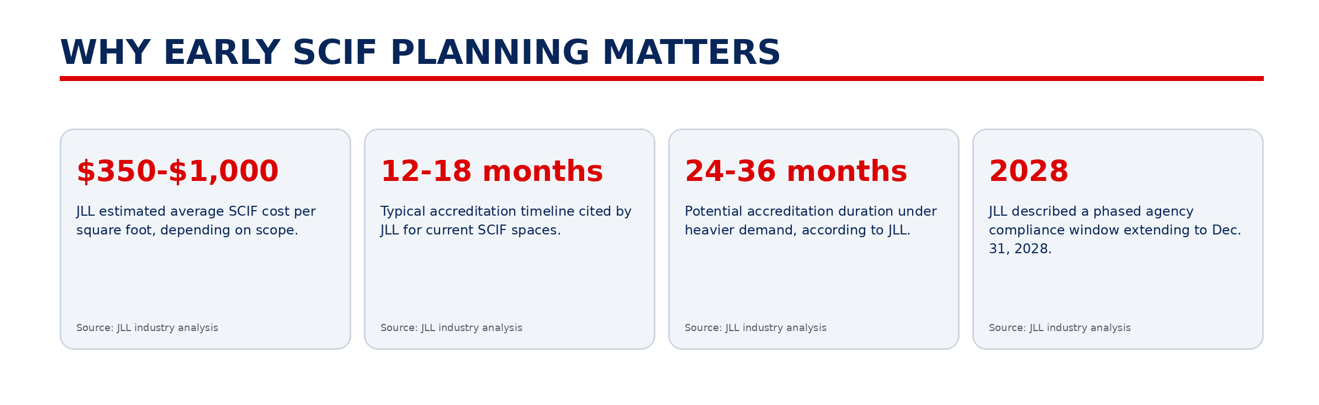
Figures above are drawn from the JLL industry analysis supplied with this article and should be treated as planning benchmarks, not universal project assumptions.
The implication is straightforward: waiting until a program is already under schedule pressure can increase the risk of longer lead times, fragmented decision-making and costly rework. Early planning creates options; late planning removes them.
Compliance Is a Construction Strategy, Not a Paperwork Exercise
SCIFs are governed by ICD/ICS 705 and the applicable Intelligence Community technical specifications, along with project- and agency-specific direction. The publicly available technical specifications are intended to provide physical and technical security requirements and best practices for new construction and renovations.
JLL’s 2025 analysis warned that evolving requirements would place greater emphasis on TEMPEST-related and radio-frequency considerations and described a phased compliance window extending across agencies to December 31, 2028. For a contractor planning work in 2026, the most useful lesson is not to assume one universal deadline or one universal assembly. The right approach is to identify the accrediting authority and technical stakeholders early, then design and build to the requirements that apply to that specific program.
That distinction matters. RF shielding, TEMPEST/EMSEC measures, acoustic targets, intrusion resistance, grounding and bonding, and other controls are not identical in every SCIF. They must be coordinated with the applicable security stakeholders, including the Accrediting Official and CTTA where required.
| TECHNICAL NOTE Surface Solutions treats RF shielding and other technical controls as project-specific systems. The goal is to build what the approved design requires—not to over-specify a generic “SCIF package.” |
Where Projects Get Into Trouble
- Late changes to shielding, door, flooring or penetration details after other trades are already installed.
- Assuming the wall assembly alone defines the secure envelope while neglecting floors, ceilings, doors, transitions and penetrations.
- Ordering long-lead secure hardware too late in the schedule.
- Poor documentation of products, installation conditions, photographs, seams, penetrations and as-built changes.
- Applying generic RF/TEMPEST assumptions instead of coordinating the actual project requirement.
|
In SCIF construction, the interfaces are where risk accumulates. Floor-to-wall transitions, wall-to-ceiling continuity, doors, frames, penetrations and trade coordination deserve the same attention as the primary assemblies. |
The SCIF Envelope Must Work as a System
Surface Solutions’ current SCIF capabilities are built around the critical layers and interfaces that turn a shell or existing room into an inspection-ready secure environment. Its work spans design/specification coordination, shielding, flooring, acoustic performance, construction integration, testing support and remediation.
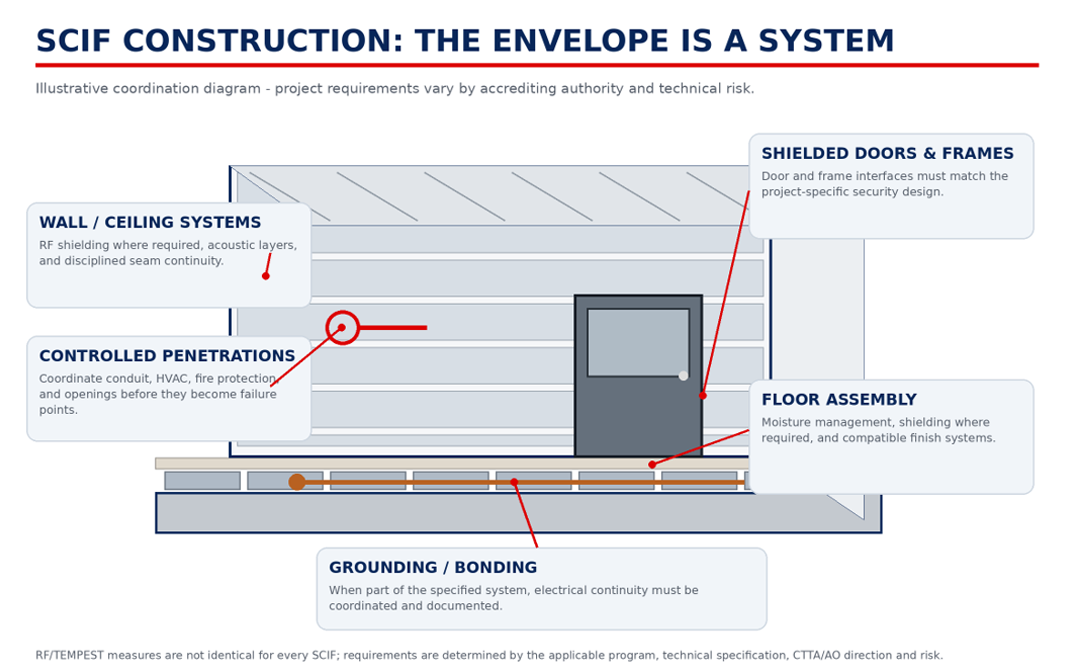
Original technical illustration prepared for this blog. It is intentionally generic; final SCIF details must follow the project-approved requirements.
A successful SCIF build is therefore less about buying individual “secure” products and more about making the entire assembly behave as a coordinated system. Surface Solutions focuses on the points where systems meet—especially transitions, penetrations and compatibility between shielding, flooring, doors, acoustic layers and adjacent construction.
Surface Solutions SCIF Capabilities
- Design and specification coordination with architects, security stakeholders and general contractors.
- Floor shielding using rigid galvanized steel panel systems where specified.
- Wall and ceiling RF shielding systems where project requirements call for them.
- RF-rated doors, frames, grounding/bonding coordination and controlled-penetration detailing.
- Moisture-controlled flooring systems and compatible resilient, carpet tile or raised-floor finishes.
- Acoustic/STC assemblies and treatment of perimeter conditions, doors, glazing and penetrations.
- Construction documentation, testing coordination, as-built records and accreditation-readiness support.
- Remediation of failed shielding, moisture, acoustic or as-built conditions when corrections are required.
Supply-Chain Pressure Can Become a Security-Schedule Risk
One of the strongest messages in the JLL analysis is that the surge in SCIF activity can create competition for specialized labor, materials and consultants. The report specifically warns of longer lead times for secure products such as vault doors and specialized hardware when manufacturers cannot keep pace with demand.
In 2026, that pressure exists inside a broader world of geopolitical and logistics volatility. The continuing conflict involving Iran has disrupted Gulf shipping and energy markets, underscoring how quickly transportation and procurement conditions can move. For a SCIF project, that does not mean every secure material is directly tied to the Gulf; it means schedule resilience matters more when specialized components already have narrow supplier bases and limited substitution options.
Unlike ordinary finish substitutions, secure-facility changes may require technical review, approval, compatibility checks or re-testing. That makes early procurement and approved alternates more important.
The Proactive Response
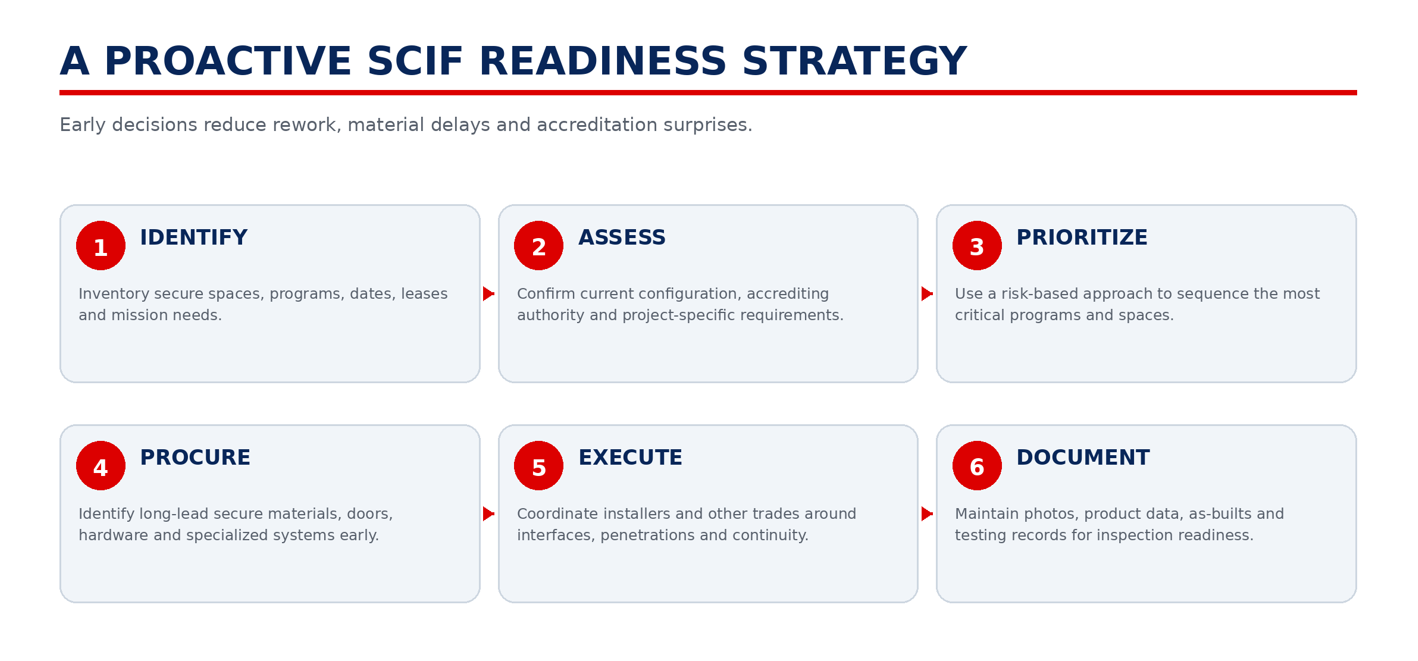
A practical readiness sequence adapted from the planning principles in the supplied JLL article and Surface Solutions’ construction approach.
JLL recommends inventorying secure spaces, confirming applicable requirements, establishing priorities and using a phased approach to minimize disruption. Surface Solutions extends that logic into construction execution: define the system early, identify long-lead components, coordinate interfaces before installation, and document the work as it progresses.
Why the DMV Is One of the Nation’s Most Important SCIF Markets
Surface Solutions is headquartered in Sterling, Virginia, in the heart of the Washington, D.C.–Maryland–Virginia (DMV) region—one of the country’s most concentrated national-security, intelligence, defense and federal-contracting ecosystems. Northern Virginia alone has a dense concentration of federal contractors and defense integrators, while the broader DMV connects major federal agencies, military installations, prime contractors, architects, security consultants and specialized construction partners.
For SCIF work, that location is more than an address. It places Surface Solutions close to the organizations that plan, fund, design, build, operate and accredit secure facilities. For general contractors, defense contractors, architects and facility owners, the value is not simply access to materials—it is access to a specialist embedded in the market where many secure-facility decisions and projects originate.
Surface Solutions’ website describes an end-to-end SCIF capability—from early design and specification through construction, RF shielding, flooring, acoustic performance, testing support and remediation. The company also coordinates compatible products and systems from specialized manufacturers, including R.A. Mayes and UZIN, where appropriate to the project.
| DMV-BASED Located in Sterling, Virginia—close to the nation’s federal, defense and intelligence ecosystem. |
SPECIALIZED Focused SCIF construction and secure-environment execution. |
SYSTEM-LEVEL Floor, wall, ceiling, door, penetration and documentation coordination. |
MISSION-FOCUSED Planning that supports inspection readiness and continuity of operations. |
Built Around PTSG
Surface Solutions’ leadership also carries forward the People–Training–Service–Growth philosophy: build strong teams, invest in training, deliver disciplined service and create sustainable growth. In SCIF construction, that philosophy translates directly into workmanship, repeatable processes, communication and accountability.
|
Secure projects demand more than products. They demand disciplined execution. Surface Solutions brings the people, training, service mindset and specialized construction focus needed to support high-stakes secure environments |
The Best Time to Solve a SCIF Problem Is Before It Reaches the Field
The new era of SCIF construction is defined by three forces arriving at the same time: a more volatile global security environment, evolving compliance expectations and growing competition for specialized resources.
Those forces reward organizations that plan early. A contractor that knows which spaces are at risk, who the accrediting stakeholders are, which materials are long-lead and where the critical construction interfaces sit is in a much stronger position than one trying to solve those questions after mobilization.
Surface Solutions is positioned from the DMV as a specialized SCIF partner for this environment—supporting design coordination, secure wall/ceiling/floor systems, shielding where required, acoustic assemblies, moisture-controlled flooring, construction documentation and remediation. That regional base gives the company a strong platform for serving the dense concentration of federal, defense and intelligence stakeholders across Washington, Northern Virginia and Maryland while continuing to support projects wherever the mission requires.
In a world of upheaval, secure infrastructure should be one less uncertainty.
| PLAN EARLY. COORDINATE THE SYSTEM. BUILD FOR INSPECTION. Surface Solutions — SCIF Installation Experts |

Sources & Editorial Notes
- JLL, “Navigating the New Era of SCIF Construction” (2025), supplied source article. Used for the market framing, cost benchmark, accreditation timing, planning recommendations and the report’s description of a phased compliance window.
- Office of the Director of National Intelligence / National Counterintelligence and Security Center, Technical Specifications for Construction and Management of Sensitive Compartmented Information Facilities (SCIFs), Version 1.5.1, public release.
- Surface Solutions website, current SCIF Services, RF Shielding, About and Team pages, reviewed September 2026.
- Virginia Department of Housing and Community Development, GO Virginia Region 7 Growth & Diversification Plan (2025), cited for Northern Virginia’s concentration of federal contractors, defense integrators and proximity to key national-security agencies.
- Maryland Department of Commerce, Military, Federal & Defense industry overview (2026), cited for Maryland’s major federal and defense presence within the broader DMV ecosystem.
- Reuters reporting dated September 7, 2026, used only to illustrate the current geopolitical volatility surrounding the U.S.-Iran conflict and Strait of Hormuz; no direct claim is made that this conflict alone creates SCIF demand.
- Editorial accuracy note: RF/TEMPEST, grounding/bonding, acoustic and other technical measures are project-specific. Final requirements must be confirmed with the applicable accrediting and technical security stakeholders.